

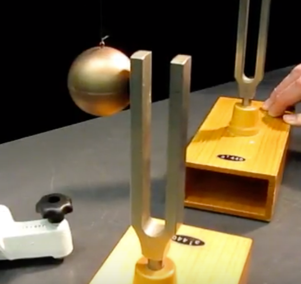
Tuning Fork Resonance + Ping Pong Ball
Description: In this video the vibration of one tuning forks is transferred through sound to another tuning fork. The ping pong balls bounces in response to this vibration. This can be used as an anchoring phenomenon in a grade 1 class but also can be used as supporting phenomenon in grades 4 and up.
Web Resources: Tuning Fork Resonance on YouTube - Flinn Scientific Tuning Fork Demonstrations
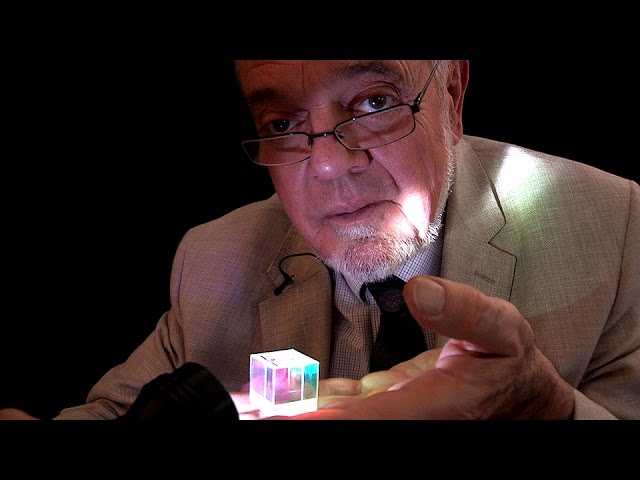
Trichroic Prism
Description: A trichroic prism splits light into three beams of light with different wavelengths (or colors). These prisms are used in some video cameras to send different colors of light to different color sensors. The prisms are coated with special coatings to filter and transmit different wavelengths of light. This device could be used to investigate interactions of light with various materials to in increasing complexity K-12.
Web Resources: Dichroic prism - Wikipedia, Trichroic Prism - Amazon
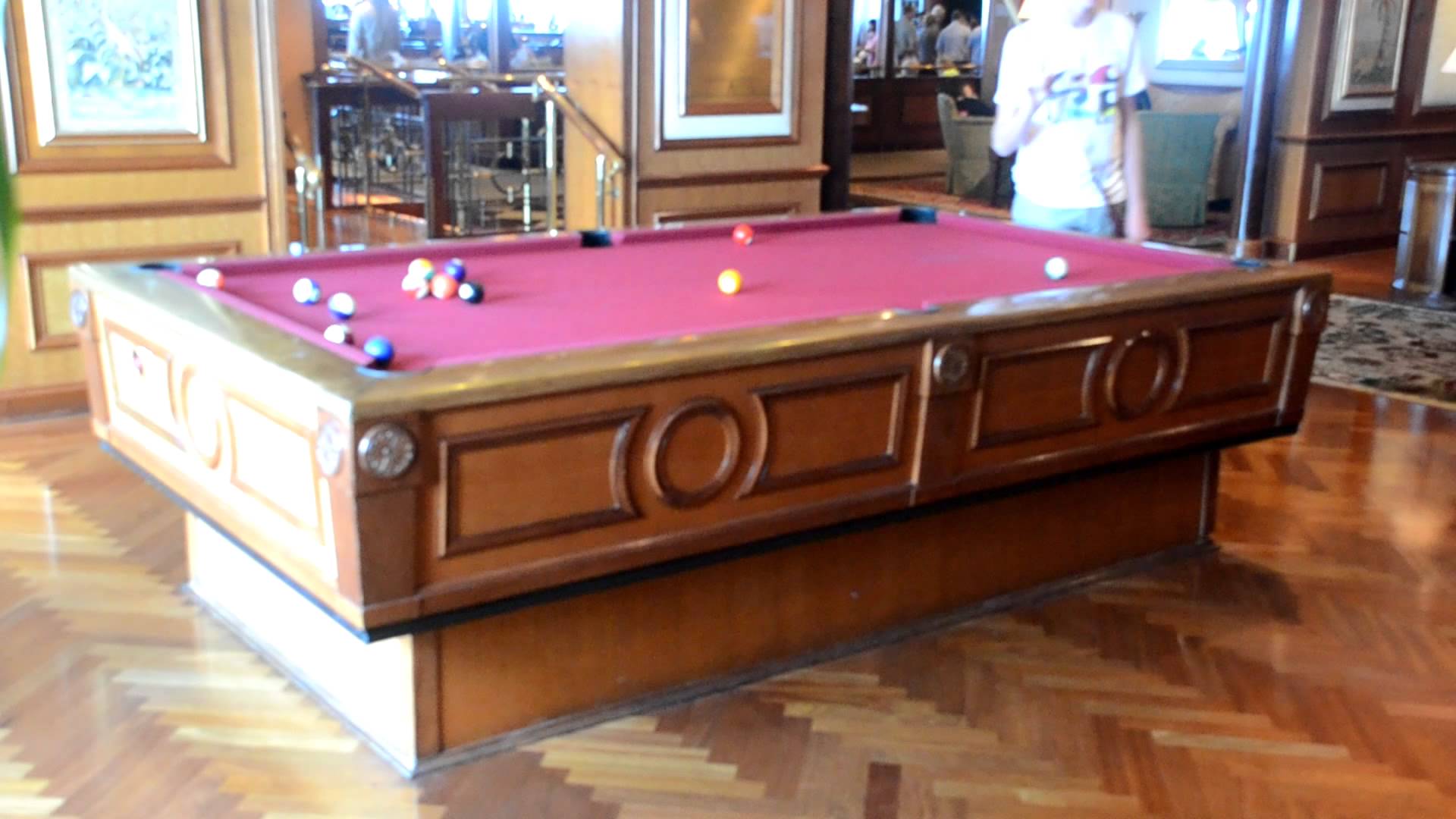
Self-Leveling Pool Table On Cruise Ship
Description: This pool table on the cruise ship Radiance of the Seas uses gyroscopic leveling to keep the pool table level during rough seas. This design solution could be used to start a unit on waves. After learning more about the amplitude, wavelength and energy of waves students could attempt to build a similar solution of their own.
Web Resources: Gyroscope used for self-leveling cruise ship pool table - Geek.com, Gyroscope - Wikipedia
Rubens' Tube
Description: The Rubens' tube was invented by German physicist Heinrich Rubens in 1905. It is a tube that is sealed at both ends in includes a flammable gas like propane. A speaker is attached to one end of the tube so sound waves can be transmitted thought the air/gas mixture. Small holes are drilled in the top of the tube and when the air/gas mixture emerges it creates a flame. As sound is played standing waves are created in the flames that change as the frequency of the waves is changed.
Web Resource: Rubens’ tube - Wikipedia

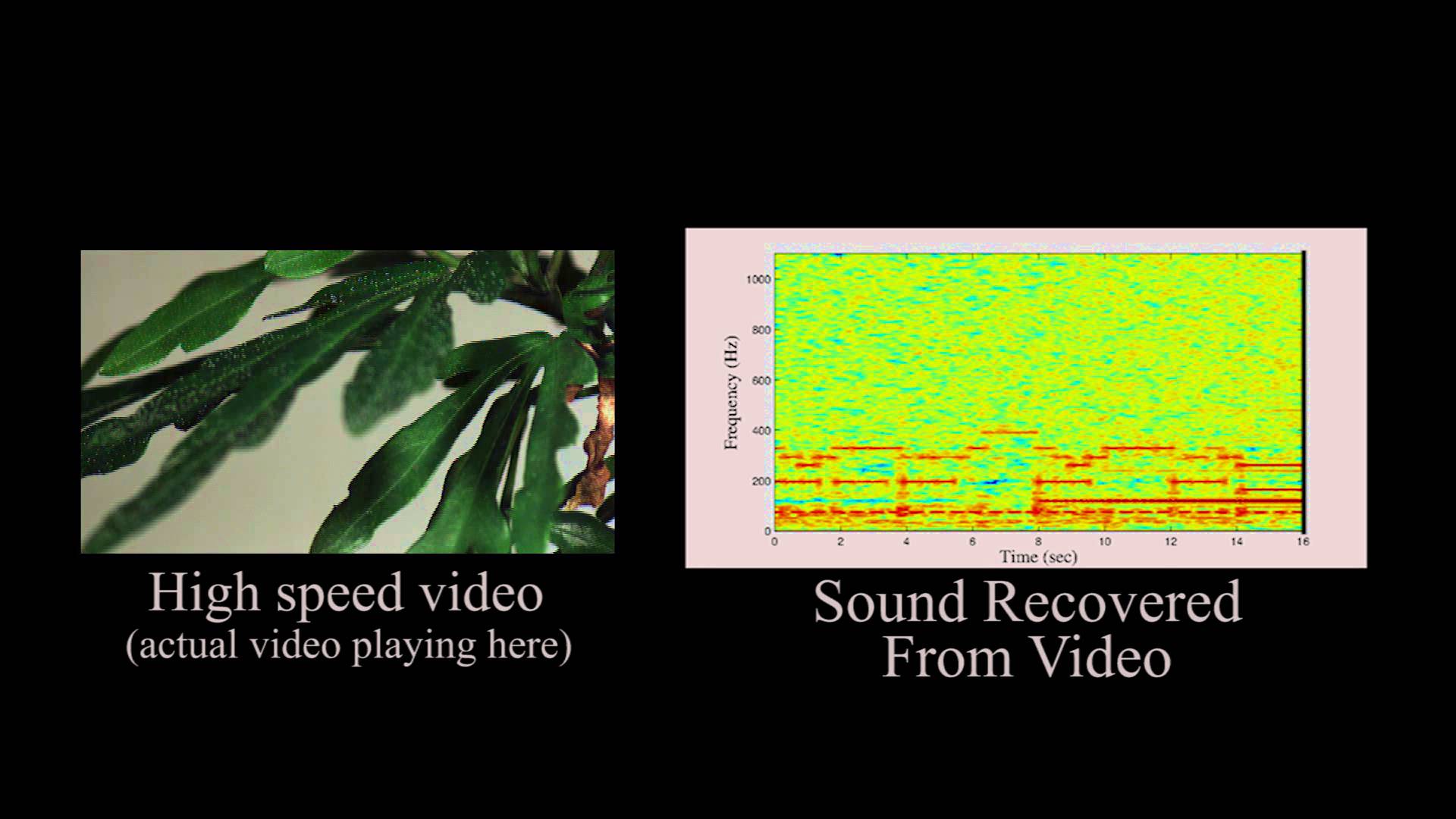
The Visual Microphone: Passive Recovery Of Sound From Video
Description: In this amazing demonstration researchers are able to extract audio from the video of an object (a plant, an empty bag, etc.) in the same room as the sound. The sound waves vibrate the object which is made visible through tiny movements processed with a graphic algorithm. This could be used as a phenomenon in a unit on sounds, waves, and information.
Web Resource: Extracting audio from visual information - MIT News
Daniel Kish Uses Echolocation To Navigate
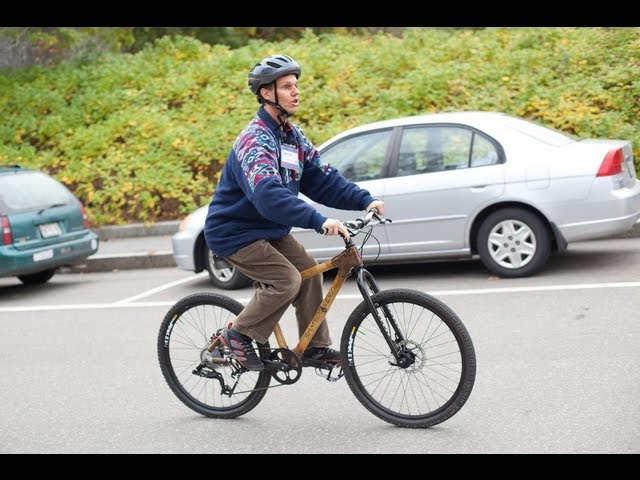
Description: Daniel Kish lost his eyes to cancer before he was 13 months old. He uses echolocation by listening to the reflection of sound waves to navigate in 3D space. He can even ride a bicycle. In addition to being an incredible story of perseverance this is a perfect phenomenon for a unit on waves. Sound waves are reflected, absorbed, and transmitted through objects in the environment and Daniel can sense the changes in energy of the returning waves.
Web Resource: Daniel Kish - Wikipedia
Analog vs. Digital Television
Description: In this video an analog and a digital television signal are compared. Many students today are not familiar with analog television and the problem of static. Analog television uses changes in the amplitude, frequency or phase of the radio waves to transmit information. Problems of this technology include susceptibility to interference (or static), color consistency, and a smaller image. Digital sends the information as a series of 0's and 1's that are converted into the pixels on the screen. It is difficult to find an analog television signals in the US but the radio is a great substitute.
Web Resource: Analog vs. Digital Television - Lifewire

Amazing Slinky Tricks
Description: The Slinky was invented by Richard James, an engineer, who was working with springs to support and stabilize equipment on a ship. Simple slinky tricks show how forces (pushes and pulls) change the direction of an object. Students can design a set of stairs, or obstacles, that the Slinky can navigate. In the secondary science classroom it can be used to investigate inertia, oscillations, and Hooke's law. This phenomenon can also be used to investigate wave properties.
Web Resource: Slinky - Wikipedia

